Filed under: School Practice
A group attainment figure can identify an inequality worth investigating. It cannot tell a teacher what one student already understands, how ambitious that student’s next task should be or what their family hopes for them.
TeacherToolkit’s October 25, 2026 commentary on white working-class educational disadvantage discusses an England-focused inquiry. Its public text distinguishes the population used in national attainment analysis from a social-grade group used in some polling, and acknowledges free-school-meal eligibility as an imperfect proxy for wider disadvantage.
The DfE Key Stage 4 methodology, in the version published on 15 October 2026 and consulted for this article, defined pupil-characteristic variables, including free-school-meal eligibility and disadvantage, separately. Those definitions are a reason to retain the exact data label and period rather than treat every use of a broad social category as the same measure.
First ask what the figure describes
Keep the cohort, period, outcome and comparison group together. Is the statement about attainment data, the views of survey respondents or a local account of experience? Each can be useful without answering the same question. A poll’s respondents are not automatically the same pupils as those represented in an attainment dataset.
This article does not reproduce the commentary’s percentages or turn its classifications into a description of every working-class family. It offers a way to keep an inequality discussion precise before connecting it to classroom practice.
Keep the learning purpose ambitious
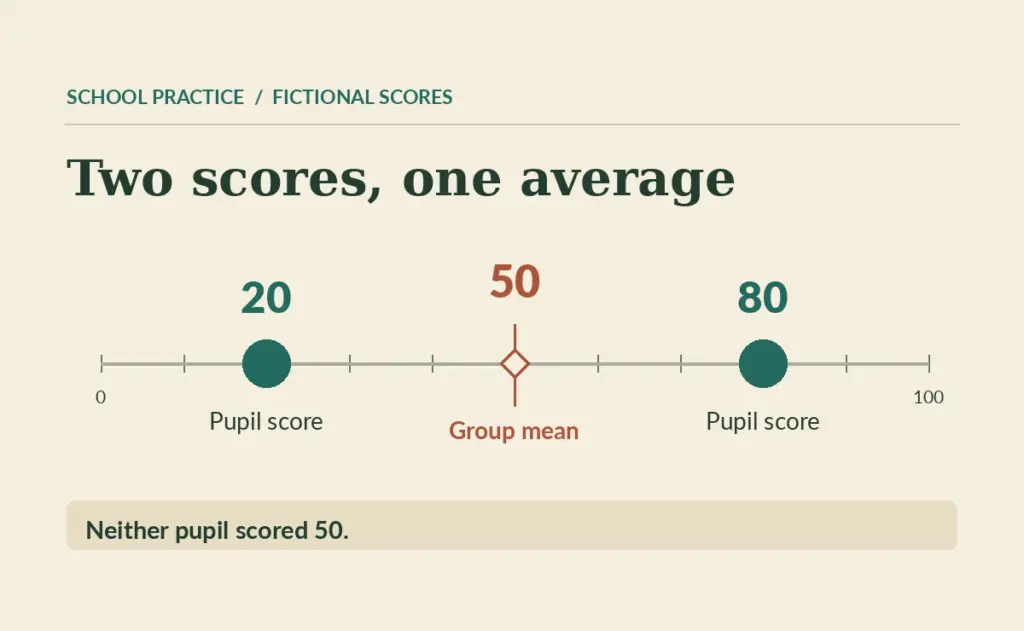
A small invented calculation shows what a mean leaves open: two scores on the same hundred-point task are 20 and 80. Their mean is 50, but neither pupil scored 50. These are fictional scores, not national data, an attainment threshold or an estimate about a social group.
Even the individual score would not identify the next teaching question without the work. A misunderstood instruction and a gap in relevant knowledge could require different responses. Investigate those possibilities with the learner and the task rather than assigning the group average to a person.
A broad group label cannot establish which explanation applies. Do not use it as a shortcut for deciding effort, aspiration, ability or the support a particular student will need.
The shared learning purpose can remain ambitious while the route into it is adjusted. A more accessible explanation or a worked example is a proposed response to an identified learning question, not a judgement about what a group is capable of.
Use group evidence to examine access
Population-level evidence can still help a school ask whether opportunities or support are distributed fairly. The mistake would be to replace that question with a prediction about an individual.
For a local review, ask which barriers are actually being described and whose accounts have been heard. A missing student response does not establish agreement, and one family’s experience should not be made to represent everyone assigned to a category.
Explain the classroom decision through its evidence
When choosing the next support, name the evidence from the task and the question it raises. Invite the student to say whether the proposed adjustment addresses the difficulty they experienced. For this task discussion, avoid asking them to explain or disclose family circumstances on behalf of a category.
The national context here is England; this is not a determination of any family’s eligibility or an evaluation of another country’s school system. The practical distinction travels more modestly: group evidence can prompt a fairness question, while a classroom decision still needs evidence about the learner and task in front of the teacher.