Filed under: School Practice
A wellbeing statistic can be important and still be easy to misdescribe. Before sharing one in a staff briefing, find the question behind it: who answered, whose experience they were describing and which period the answer covered.
TeacherToolkit’s October 2026 discussion of inspection and wellbeing raises concerns about combining different provider groups. The underlying IFF Research interim evaluation, published by Ofsted on 9 October 2026, lets readers check the method and question wording directly. It concerns England and an early implementation period of the renewed inspection framework.
Start with the person behind the response
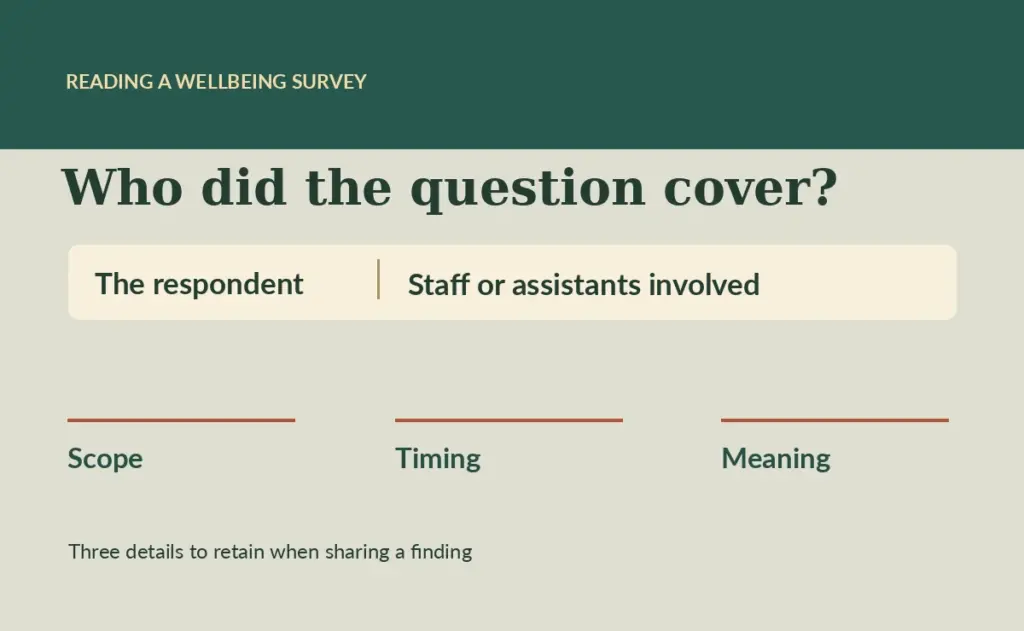
The evaluation’s wellbeing item asks about a negative effect on the respondent or on staff or assistants involved in inspection. An answer therefore does not necessarily describe the respondent alone. Calling the result a measurement of every headteacher’s mental health would change both the population and the meaning of the question.
The item records respondents’ accounts of an inspection-related effect. That matters as evidence of their experience. It does not, by itself, provide a clinical diagnosis or isolate inspection from every other influence on wellbeing.
Keep three notes beside the finding
For a staff discussion, a small source card could record:
- Scope: the provider group and the people covered by the question.
- Timing: the inspection period and when the survey was completed.
- Meaning: the experience respondents were asked to report, including the response categories used.
The interim report covers four survey waves relating to inspections from January 2026 with reports published before the end of May 2026. It acknowledges differing response rates, uses weighting and notes that the time between inspection and survey completion varied. Weighting does not establish that people who did not respond had the same experiences as those who did. These details belong alongside a finding rather than disappearing when it becomes a slide.
Check the sentence you intend to share
Imagine a briefing draft says that leaders’ wellbeing improved because respondents found an inspection less worrying than expected. That wording makes two jumps. A comparison with an expectation does not tell us the absolute level of distress, and a reported experience does not automatically establish a change caused by the framework.
A more careful briefing could describe the particular question answered, identify the group and retain the report’s date. When comparing findings, keep the same response categories in view. A broad category that includes a small negative effect answers a different question from one limited to larger reported effects.
Use the reading to improve a local conversation
A team might then ask which parts of preparation created avoidable duplication, what support colleagues found useful and whether any concerns remain unresolved. Those are proposed discussion prompts, not findings about the school. Offer a private route for comments and explain who will see them.
Record which point came from the published survey and which came from local experience. That distinction allows the team to take concerns seriously while making a practical decision about its own workload and support.