Filed under: School Practice
You ask the class to explain an answer. Nobody responds. The pause tells you that an answer has not yet been shared; it leaves several possible explanations open. Students may need more preparation, the wording may be unclear, or the available way of responding may be difficult for someone to use.
In its October 2026 article on classroom questioning, TeacherToolkit discusses thinking time, prompts and structured discussion. The public text introduces those ideas but does not present a study establishing one best response to every silence. Here is one optional way to investigate a pause without assigning a motive to the student.
Make the thinking task visible
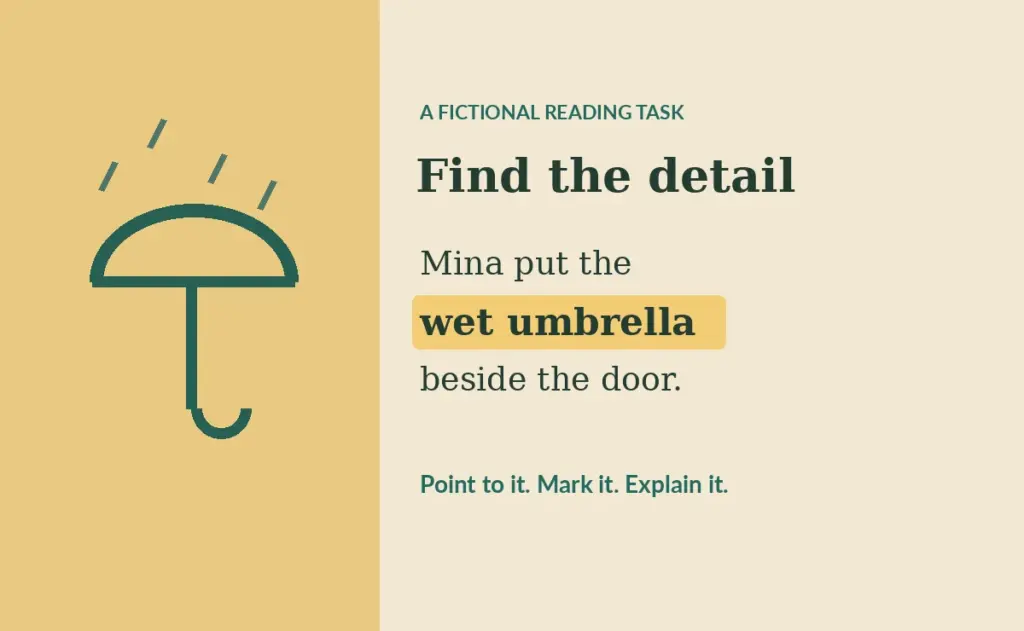
Use a sentence invented for this example: “Mina put the wet umbrella beside the door.” Ask which detail makes recent rain a plausible interpretation. A student who says nothing but points to “wet umbrella” has offered something relevant to discuss. That does not yet explain the inference or prove that rain is the only possible cause.
The next question can concern the link between the detail and the interpretation. It is a more precise response than treating the silence as a complete account of understanding or willingness. This is fictional text and a fictional response, not a diagnosis or a classroom observation. Clarify the question before interpreting the evidence it produces.
Ask students to choose a detail. They could mark it, note a few words, point to a line or prepare an oral explanation. Choose routes that fit the students’ existing communication arrangements and the purpose of the task. No public account of a personal difficulty is needed to use an offered route.
Separate preparation from public performance
Explain how an answer will be shared before preparation begins. A student might offer their own explanation, agree that the teacher can read an unsigned response, or use a brief exchange with a partner where that arrangement is suitable. Allow a private response. Before sharing an unsigned contribution, check permission and avoid assuming that classmates could not recognise it.
Match the response route to the learning goal. A spoken explanation calls for practice and support. A reading check can start with the relevant detail and the student’s reason for choosing it.
Look for the next piece of information
A selected line gives you something specific to discuss. Ask how it supports the interpretation. If a student has chosen a relevant detail but cannot yet explain the connection, model that step and offer another supported attempt. If the question itself was misunderstood, return to its meaning.
Keep the conclusion close to the response. Note which prompts and support were available so that a supported explanation is not described as an independent one. A blank note does not reveal why it is blank, and a confident answer does not establish what everyone else understood. A short private check can be more informative than guessing from the room’s silence.
Ask about the response route
After the activity, invite a small piece of feedback: which part of preparing or sharing the answer was manageable, and what would make the next attempt easier to use? Students can indicate an option or comment privately rather than explain themselves in front of peers.
Use the feedback to change one thing in the next question and observe which part of the task students can then show. Keep the support they used alongside that observation.